The Evolution and Future of the Calculator: From Abacus to AI-Powered Analytics
Executive Insights
- The abacus (2700 BCE) is the oldest computing tool, while the 1960s marked the transition to electronic calculators.
- Graphing calculators revolutionized education in 1985 by allowing students to visualize mathematical functions.
- Physical calculators offer distraction-free, exam-compliant reliability, while online calculators offer specialized, cloud-powered versatility.
- AI is transforming calculators from simple computation devices into analytical engines that can explain the ‘how’ and ‘why’ of a solution.
- Future calculators will likely be integrated into AR and voice assistants, moving away from manual input.
Introduction: The Unsung Hero of Computation
In an era dominated by generative AI and supercomputers, the humble calculator remains one of the most significant tools in human history. Far more than a simple device for addition and subtraction, the calculator represents humanity’s relentless pursuit of precision and efficiency. From the ancient abacus used by merchants in Mesopotamia to the cloud-based AI solvers of today, the calculator has evolved from a physical aid to a digital ecosystem.
For students, engineers, and financial analysts, the calculator is indispensable. However, the definition of what constitutes a "calculator" is shifting. Is it a handheld device with rubber buttons? Is it a browser tab? Or is it a voice-activated AI that solves calculus problems in real-time? This comprehensive guide explores the rich history, diverse types, and the futuristic trajectory of calculators, analyzing how they continue to shape our understanding of mathematics.
The Historical Timeline: From Beads to Microchips
The journey of the calculator is a timeline of innovation, marking the transition from manual counting to mechanical gearing, and finally, to electronic processing.
Ancient Origins: The Abacus
Long before electricity, the abacus served as the world’s first computing device. Originating around 2700 BCE in Sumeria, and later refined by the Chinese, Greeks, and Romans, the abacus used sliding beads on rods to represent decimal places. It was not a calculator in the modern sense—it did not "calculate" for you—but rather a storage device for numbers that allowed the human brain to process arithmetic at high speeds.
The Mechanical Revolution (17th – 19th Century)
The true ancestors of the modern calculator emerged during the Renaissance. In 1623, Wilhelm Schickard invented the "Calculating Clock," the first machine capable of automatically adding and subtracting. Shortly after, Blaise Pascal developed the Pascaline in 1642 to assist his tax-collector father. These devices used intricate systems of gears and wheels.
However, the industry truly launched with the Arithmometer in 1820. Invented by Charles Xavier Thomas de Colmar, it was the first commercially successful mechanical calculator, capable of performing all four basic operations. It remained in use until World War I, bridging the gap between bespoke invention and mass production.
The Electronic Shift (20th Century)
The mid-20th century saw the vacuum tube replace the gear. The ANITA MK-8 (1961) was the first all-electronic desktop calculator, but it was the size of a typewriter and weighed heavily. The race for miniaturization began with the invention of the transistor.
Texas Instruments changed the world in 1967 with the "Cal Tech" project, the prototype for the first handheld calculator. By 1971, the Busicom LE-120A "HANDY" became the first truly pocket-sized calculator using an LED display. This era democratized math; what was once the domain of human "computers" and expensive mainframes fits in a shirt pocket.
Types of Calculators and Their Modern Utility
Today, calculators are specialized tools tailored to specific industries. Understanding the distinctions is crucial for selecting the right tool.
| Type | Target User | Key Features |
|---|---|---|
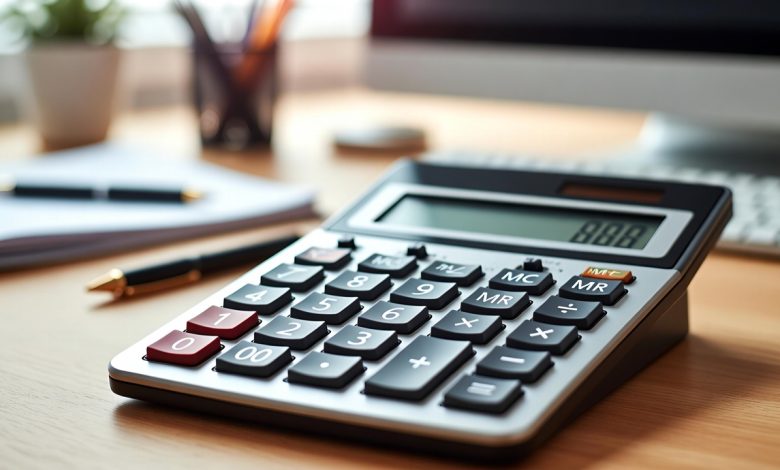
| Basic Calculator | General Public, Elementary Students | Four basic functions (+, -, ×, ÷), memory (M+, M-), percentage (%). Solar or battery powered. |
| Scientific Calculator | High School/College Students, Engineers | Trigonometry (sin, cos, tan), logarithms, exponents, parenthesis for order of operations. |
| Graphing Calculator | STEM Majors, Statisticians | Large screen for plotting functions (y=x²), solving systems of equations, programming capabilities (Python/BASIC). |
| Financial Calculator | Bankers, Realtors, Accountants | Time Value of Money (TVM), amortization, NPV (Net Present Value), IRR (Internal Rate of Return). |
| Printing Calculator | Accountants, Retailers | Built-in paper roll to provide a physical audit trail of calculations for tax and bookkeeping. |
The Graphing Calculator Dominance
In the education sector, the graphing calculator (e.g., TI-84 Plus, Casio fx-series) remains a staple. Unlike basic scientific models, these devices allow students to visualize concepts. The introduction of the Casio fx-7000G in 1985 marked the first time a handheld device could plot graphs. Modern versions now feature high-resolution color screens and rechargeable batteries, yet they retain the tactile keypad favored in standardized testing environments.
Physical vs. Online Calculators: The Digital Divide
With the rise of smartphones, the debate between physical devices and online apps has intensified. Why buy a $100 TI-84 when a free app can do the same?
The Case for Physical Calculators
- Distraction-Free Environment: In academic settings, physical calculators prevent students from accessing social media or the internet during exams.
- Tactile Feedback: The physical click of a button confirms input, reducing error rates in high-speed data entry (common in accounting).
- Battery Life: A standard solar-powered calculator can last years without a battery change, whereas a phone app drains the device’s daily power.
- Exam Standardization: Most standardized tests (SAT, ACT, CFA) strictly regulate calculator use, often banning smartphones entirely.
The Case for Online and Cloud Calculators
- Specialization: The internet offers millions of niche calculators not possible on a standard device—mortgage amortization, BMI, concrete volume for construction, or pregnancy due dates.
- Processing Power: Online tools leverage cloud servers to solve complex algorithms (like integral calculus) instantly, which might lag on a handheld chip.
- Visuals and UI: Web-based calculators can display dynamic, interactive charts that update in real-time as inputs change.
The Rise of AI Calculators: Beyond Arithmetic
The most profound shift in recent years is the integration of Artificial Intelligence (AI) into calculation. Traditional calculators are "deterministic"—they strictly follow programmed logic (2+2 always equals 4). AI calculators, however, are "probabilistic" and analytical.
Wolfram Alpha and Symbolic Computation
Tools like Wolfram Alpha paved the way by not just giving an answer, but showing the steps. This "symbolic computation" helps students understand the methodology. Unlike a standard calculator that gives a decimal approximation, AI tools can manipulate algebraic symbols to solve for variables.
Generative AI and the "Calculator Effect"
Generative AI models, such as ChatGPT and Google Gemini, have introduced natural language processing to math. You can now ask, "Calculate the monthly cost of electricity in New York for a 900 sq ft apartment" and the AI will estimate based on data, rather than just crunching numbers you provide.
However, this leads to the "Calculator Effect"—a concern that reliance on AI will erode basic human analytical skills, much like critics in the 1970s feared electronic calculators would destroy mental arithmetic. While calculators successfully offloaded computation, AI is now offloading reasoning.
Future Trends: Voice, AR, and Predictive Math
The future of the calculator is invisible and ubiquitous. It is moving away from a dedicated hardware device toward an integrated software layer.
- Augmented Reality (AR) Math: Apps like Photomath already allow users to scan a handwritten equation with a camera to solve it. Future iterations using smart glasses will project the solution steps directly onto the paper.
- Voice-Activated Analytics: Professionals will soon dictate complex financial scenarios to AI assistants (e.g., "Run a scenario where interest rates rise by 0.5%"), receiving verbal and visual breakdowns instantly.
- Predictive Calculation: Instead of waiting for input, future "smart" calculators integrated into OS systems will predict necessary calculations based on user context (e.g., automatically calculating tips or currency conversion based on GPS location).
Conclusion
The calculator has journeyed from the wooden beads of the abacus to the neural networks of AI. While the form factor changes, the core purpose remains: to extend the human mind’s capacity for logic and quantification. Whether you are a student relying on a TI-84 for an exam or a developer using a cloud-based API, the calculator remains the essential bridge between problem and solution.
In-Depth Q&A
Q: Who invented the first calculator?
The first mechanical calculator, the ‘Calculating Clock’, was invented by Wilhelm Schickard in 1623. However, the abacus, used for manual calculation, dates back to around 2700 BCE.
Q: What is the difference between a scientific and a graphing calculator?
A scientific calculator handles advanced math functions like trigonometry, logarithms, and exponents. A graphing calculator includes all scientific functions but adds a larger screen and processor to plot graphs, solve systems of equations visually, and run programs.
Q: Are online calculators accurate?
Yes, for standard math and financial formulas, online calculators are highly accurate. However, for specialized calculations (like tax or medical data), user input errors or outdated algorithms on unverified sites can lead to inaccuracies.
Q: Why are graphing calculators still so expensive?
Graphing calculators remain expensive due to a monopolistic market structure (dominated by Texas Instruments), the cost of specialized, durable hardware required for standardized testing, and the niche nature of the product compared to mass-market smartphones.
Q: Can AI replace traditional calculators?
AI can replace calculators for solving problems, but not for learning. AI offers reasoning and steps, which is powerful, but traditional calculators are still preferred in testing environments to ensure students demonstrate their own understanding without AI assistance.