Executive Insights
- Amazon’s 2025 revenue is estimated at ~$714 billion, with AWS contributing ~$128 billion.
- The ‘Nova’ AI model family marks Amazon’s serious entry into the generative AI model market.
- Workforce restructuring has led to ~30,000 corporate job cuts between late 2025 and early 2026.
- Physical retail tech is scaling back, with the discontinuation of the Amazon One palm scanner.
- AWS remains the profit engine, growing ~19-20% YoY driven by AI infrastructure demand.
Executive Summary
As of early 2026, Amazon.com, Inc. (NASDAQ: AMZN) stands at a critical juncture of technological transformation and operational efficiency. Following a robust 2025 with total annual revenues estimated at ~$714 billion, the company has aggressively pivoted toward generative AI, restructuring its workforce, and refining its physical retail footprint. The discontinuation of the Amazon One palm-recognition system and the launch of the Nova AI model family signal a strategic refocusing on scalable, high-margin technologies over experimental retail concepts.
Financial Performance & Market Position
Amazon’s financial trajectory remains strong, driven by the dual engines of e-commerce volume and cloud computing profitability. The company’s focus on operational discipline has led to record operating margins.
| Metric | 2024 (Actual) | 2025 (Est.) | YoY Growth |
|---|---|---|---|
| Total Revenue | $638 Billion | ~$714 Billion | ~12% |
| AWS Revenue | $108 Billion | ~$128 Billion | ~19% |
| Prime Subscribers | ~230 Million | >240 Million | ~4.3% |
| Global Workforce | 1.55 Million | 1.56 Million | 0.6% |
Amazon Web Services (AWS) Dominance
AWS continues to be the profit powerhouse, holding approximately 31% of the global cloud infrastructure market in 2026. The division reported Q3 2025 revenue of $33 billion (+20% YoY), driven by the mass adoption of generative AI workloads. The backlog for AWS services has swelled to over $200 billion, indicating sustained enterprise demand for AI-ready infrastructure.
Technological Innovations: The AI Pivot
2026 marks Amazon’s full-scale entry into the generative AI arms race, moving beyond infrastructure provider to model creator.
Project Olympus & The Nova Model Family
Amazon has officially deployed its proprietary foundation models, previously codenamed “Olympus.” The public-facing lineup, branded as Amazon Nova, includes four distinct tiers designed to compete directly with GPT-4 and Google’s Gemini:
- Nova Micro (~11B parameters): Optimized for edge devices and low-latency tasks.
- Nova Lite (~20B parameters): A cost-effective solution for high-volume summarization and chatbots.
- Nova Pro (~90B parameters): The workhorse model for enterprise reasoning and coding tasks.
- Nova Premier (~470B dense / 2T MoE): The flagship multimodal model capable of processing text, images, and video with reasoning capabilities rivaling the industry’s best.
Agentic AI & Robotics
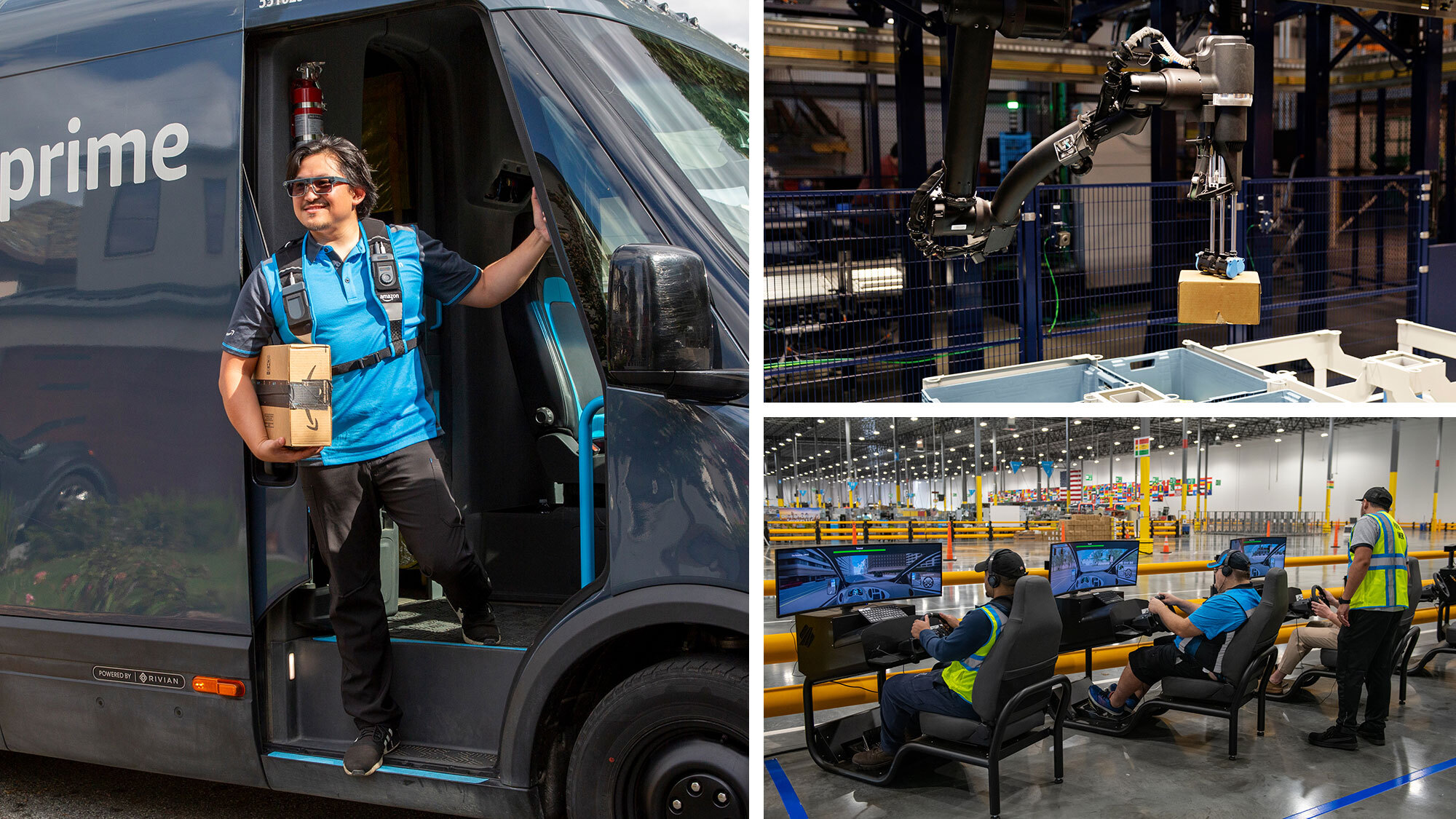
Inside its fulfillment centers, Amazon has introduced Project Eluna, an agentic AI system that optimizes inventory placement and predicts regional demand surges with unprecedented accuracy. This is complemented by Blue Jay, a new robotic arm system capable of handling 65% of Amazon’s product inventory, significantly reducing human ergonomic strain and processing time.
Strategic Shifts & Workforce Restructuring
In a move to “reduce bureaucracy and increase ownership,” Amazon executed significant workforce reductions between October 2025 and January 2026, eliminating approximately 30,000 corporate roles. This restructuring primarily affected middle management and non-engineering divisions, signaling a flatter organizational structure.
Retail Strategy: Physical vs. Digital
Amazon has made decisive cuts to its physical retail experiments:
- Amazon One Discontinued: The palm-scanning payment technology will be fully phased out by June 2026 due to privacy concerns and slow adoption.
- Grocery Pivot: The company is closing underperforming Amazon Fresh locations to focus resources on Whole Foods Market and an enhanced online grocery delivery experience.
Sustainability & Regulatory Landscape
Environmental Progress
Amazon achieved its goal of matching 100% of electricity consumption with renewable energy in 2024, notably five years ahead of schedule. The focus for 2026 has shifted to water stewardship, with a commitment to becoming water positive by 2030 (returning more water to communities than it uses).
Antitrust Challenges
The regulatory environment remains hostile. The FTC antitrust trial is scheduled for late 2026, focusing on allegations that Amazon illegally maintains monopoly power in online superstore services and marketplace logistics. The outcome of this trial could force structural changes to how Amazon treats third-party sellers.
Conclusion
Amazon in 2026 is a leaner, more AI-centric organization. By shedding experimental hardware and retail concepts that failed to scale, the company has doubled down on its core moats: the logistics network and the AWS cloud. With the Nova AI models now integrated into its ecosystem, Amazon is well-positioned to defend its dominance against rising competition from nimble AI startups and legacy tech giants alike.
In-Depth Q&A
Q: What is Amazon’s revenue for 2025?
Amazon’s total estimated revenue for the full year 2025 is approximately $714 billion, representing a year-over-year growth of about 12% from $638 billion in 2024.
Q: What is Amazon Nova?
Amazon Nova is the company’s new family of proprietary generative AI models, launched to compete with OpenAI’s GPT-4. It ranges from the efficient ‘Nova Micro’ to the powerful flagship ‘Nova Premier,’ which features multimodal capabilities.
Q: Did Amazon have layoffs in 2026?
Yes, Amazon confirmed a reduction of approximately 16,000 corporate roles in January 2026. Combined with cuts in October 2025, the company has eliminated roughly 30,000 corporate positions in a four-month period.
Q: Is Amazon One being discontinued?
Yes, Amazon announced it will discontinue its Amazon One palm-recognition payment technology by June 2026, citing limited consumer adoption and a strategic pivot away from physical retail tech experiments.
Q: What is Amazon’s market share in cloud computing?
As of 2026, Amazon Web Services (AWS) holds approximately 31% of the global cloud infrastructure market, maintaining its leadership position against competitors like Microsoft Azure and Google Cloud.